Abrasive Waterjet Cutter Basics in Advanced Manufacturing Systems
An abrasive waterjet cutter is a precision cutting system that uses high-pressure water mixed with abrasive particles to cut hard and soft materials. This technology is widely used in industrial manufacturing because it can cut complex shapes without generating excessive heat. Unlike traditional cutting methods, abrasive waterjet cutting maintains material integrity and reduces thermal damage.
The process is suitable for metals, ceramics, glass, stone, composites, plastics, and engineered materials. Industries such as aerospace, automotive, electronics, construction, and industrial fabrication rely on waterjet systems for accurate and efficient production.
Modern abrasive waterjet cutters are often integrated with CNC automation systems, allowing manufacturers to achieve detailed designs and repeatable cutting performance.
How Abrasive Waterjet Cutting Works
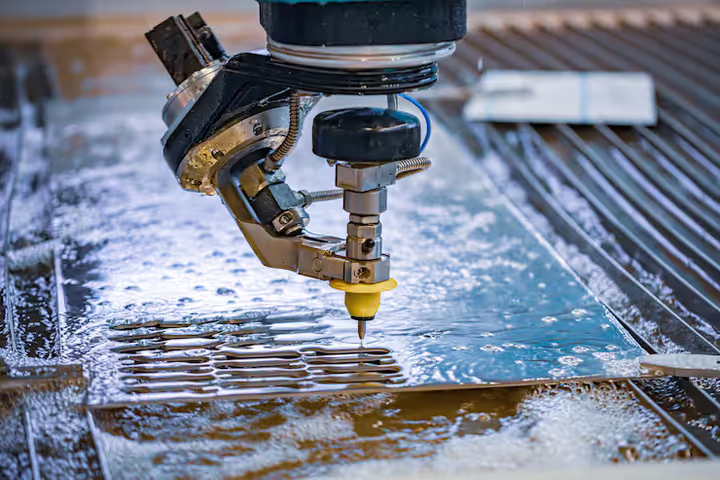
An abrasive waterjet cutter operates by pressurizing water to extremely high levels, often exceeding 50,000 PSI. The water is forced through a small nozzle, creating a high-speed stream. Abrasive materials such as garnet are added to the stream to improve cutting strength.
The abrasive particles erode the target material while the CNC-controlled nozzle follows programmed cutting paths.
Main Steps in the Process
- Water is pressurized using a high-pressure pump
- Abrasive particles are mixed into the water stream
- The nozzle directs the stream onto the material surface
- CNC software controls movement and cutting patterns
- The material is cut with minimal heat distortion
This process allows manufacturers to produce smooth edges and detailed shapes with high dimensional accuracy.
Major Components of an Abrasive Waterjet Cutter
The system contains several important components that work together to maintain cutting precision and operational efficiency.
| Component | Function |
|---|---|
| High-Pressure Pump | Generates pressurized water for cutting |
| Cutting Head | Directs the abrasive water stream |
| Abrasive Hopper | Stores and feeds abrasive material |
| CNC Controller | Manages automated cutting operations |
| Nozzle | Focuses the cutting stream |
| Catch Tank | Absorbs water and cutting debris |
| Motion System | Controls cutting movement and positioning |
These components are designed to withstand harsh industrial environments and continuous operation.
Types of Abrasive Waterjet Cutting Systems
Different waterjet systems are designed for specific industrial applications and production requirements.
Pure Waterjet Systems
- Use only high-pressure water
- Suitable for rubber, foam, paper, and soft materials
- Common in packaging and textile industries
Abrasive Waterjet Systems
- Combine water with abrasive particles
- Used for metals, ceramics, stone, and composites
- Preferred for heavy industrial manufacturing
CNC Waterjet Machines
- Operate through computer-controlled automation
- Support complex cutting paths and repeatable production
- Widely used in aerospace and automotive sectors
Robotic Waterjet Systems
- Integrated with robotic arms
- Used for three-dimensional cutting applications
- Helpful in advanced manufacturing environments
Importance of Abrasive Waterjet Cutters
Abrasive waterjet cutting technology plays an important role in modern manufacturing because it supports precision, flexibility, and material protection.
Traditional thermal cutting methods can create heat-affected zones that weaken materials. Waterjet systems eliminate this issue by using a cold-cutting process. This makes them valuable for industries that require structural integrity and precision engineering.
Manufacturers also use abrasive waterjet cutters to reduce waste and improve material utilization. Since the cutting stream is narrow, less material is removed during processing.
Key Benefits
- Minimal thermal distortion
- High cutting precision
- Suitable for multiple materials
- Reduced material waste
- Cleaner edge quality
- Lower need for secondary finishing
These advantages help industrial operations improve productivity and maintain consistent quality standards.
Industrial Applications
Abrasive waterjet cutters are used across many industrial sectors because of their flexibility and precision capabilities.
Aerospace Manufacturing
- Cutting titanium and composite materials
- Producing turbine and aircraft components
- Supporting precision engineering requirements
Automotive Production
- Fabricating metal panels and components
- Cutting interior materials and insulation
- Assisting prototype development
Construction and Architecture
- Processing marble, granite, and stone
- Creating decorative patterns
- Producing custom structural components
Electronics Industry
- Cutting delicate materials without heat damage
- Supporting circuit board and enclosure manufacturing
- Maintaining precision in compact designs
Medical Equipment Manufacturing
- Producing surgical instrument parts
- Cutting stainless steel and specialty alloys
- Supporting accurate component fabrication
Materials Commonly Cut by Waterjet Systems
Waterjet cutting systems can process a wide range of materials without significant mechanical stress.
Frequently Processed Materials
- Stainless steel
- Aluminum
- Titanium
- Copper
- Glass
- Granite
- Ceramics
- Carbon fiber composites
- Rubber
- Plastics
This versatility makes abrasive waterjet systems highly valuable in mixed-material manufacturing environments.
Advanced Features in Modern Systems
Modern abrasive waterjet cutters include advanced technologies that improve efficiency, automation, and precision.
Common Advanced Features
- CNC automation integration
- Smart pressure monitoring
- Real-time diagnostics
- AI-supported cutting optimization
- Multi-axis cutting capability
- Remote system monitoring
- Energy-efficient pump systems
Manufacturers are increasingly adopting industrial automation tools to improve production accuracy and reduce operational downtime.
Recent Trends and Developments
The abrasive waterjet cutting industry has experienced several technological advancements during 2025 and 2026.
Automation and Smart Manufacturing
- Manufacturers are integrating waterjet systems into Industry 4.0 environments.
- Smart sensors and industrial IoT systems now monitor pressure levels, nozzle wear, and maintenance schedules in real time.
AI-Based Cutting Optimization
- In 2025, several CNC software developers introduced AI-assisted cutting path optimization.
- These systems help improve material usage and reduce cutting time.
- New high-pressure pump technologies released during 2025 focus on lower energy consumption while maintaining cutting performance.
Energy Efficiency Improvements
- This supports sustainability goals in industrial manufacturing.
- The growing use of carbon fiber and engineered composites in aerospace and electric vehicle manufacturing has increased demand for precision waterjet cutting solutions.
- Some industrial manufacturers now combine abrasive waterjet technology with laser and plasma cutting systems to support multi-process production environments.
Safety Standards and Regulations
Industrial waterjet cutting systems must follow workplace safety and equipment regulations to ensure safe operation.
Common Regulatory Considerations
- Occupational safety standards for high-pressure systems
- Noise exposure regulations
- Water recycling and waste disposal guidelines
- Industrial machine guarding requirements
- Abrasive material handling procedures
In many regions, manufacturers follow standards established by workplace safety authorities and industrial equipment organizations. Proper operator training and regular maintenance are essential for compliance.
Useful Software and Learning Resources
Several digital tools and educational resources support abrasive waterjet cutting operations and technical learning.
Common Software Platforms
- CNC programming software
- CAD/CAM design systems
- Industrial automation monitoring tools
- Predictive maintenance platforms
Educational Resources
- Manufacturing engineering courses
- Industrial automation training programs
- CNC machining workshops
- Technical documentation from equipment manufacturers
- Engineering research publications
These resources help technicians and manufacturers improve operational efficiency and technical understanding.
Challenges in Abrasive Waterjet Cutting
Although abrasive waterjet systems provide many advantages, some operational challenges still exist.
Common Challenges
- Nozzle wear during extended operation
- Abrasive material consumption
- High-pressure system maintenance
- Slower cutting speeds for thick materials
- Water management requirements
Manufacturers often address these challenges through preventive maintenance programs and advanced monitoring systems.
Future Outlook
The future of abrasive waterjet cutting technology is closely connected to industrial automation and precision manufacturing growth. As industries demand more efficient and environmentally responsible production methods, waterjet systems are expected to become more intelligent and energy efficient.
AI-assisted manufacturing, robotic automation, and advanced CNC integration are likely to improve cutting precision further. Increased adoption in aerospace, renewable energy, and electric vehicle production may also expand the role of abrasive waterjet technology.
FAQs
What is an abrasive waterjet cutter used for?
An abrasive waterjet cutter is used for precision cutting of materials such as metal, stone, glass, composites, and ceramics. It is widely used in industrial manufacturing and fabrication.
Does abrasive waterjet cutting generate heat?
No. Abrasive waterjet cutting is considered a cold-cutting process because it does not create significant heat-affected zones in materials.
Which abrasive material is commonly used in waterjet systems?
Garnet is the most commonly used abrasive material because of its hardness, cutting performance, and reliability.
Can waterjet cutters process thick materials?
Yes. Industrial abrasive waterjet systems can cut thick materials, including steel plates and stone slabs, while maintaining precision.
Are CNC systems important in waterjet cutting?
Yes. CNC technology improves automation, cutting accuracy, repeatability, and complex shape production in modern waterjet systems.
Conclusion
Abrasive waterjet cutters are an important part of modern industrial manufacturing because they provide precise, flexible, and heat-free cutting capabilities. Their ability to process a wide variety of materials makes them suitable for industries ranging from aerospace to construction.
Advancements in CNC automation, AI-based optimization, and energy-efficient systems continue to improve the performance of waterjet technology. As industrial manufacturing evolves toward smarter and more sustainable production methods, abrasive waterjet cutting systems are expected to remain a valuable solution for precision fabrication and advanced material processing.